The National Foundation for Medical Research and Innovation has implemented a strategy focused on supporting gap areas along the innovation pathway for biomedical research.
This targeted support assists researchers to advance their research towards the development of new innovations including medicines, vaccines, diagnostics and devices. These innovations normally require regulatory approval, commercial partnerships and investors as they progress. Learn more.

| Prof Roger Chung |
| Macquarie University |
| Amyotrophic lateral sclerosis |
| Therapeutics |
- Establishment of spin-off company, Celosia Therapeutics ($2 million seed funding followed by series A of $16.5 million)
- Commenced Phase 1b KOANEWA trial evaluating CTx1000 in March 2026
- Fight MND Foundation Impact Grant, $250,000
- Fight MND Foundation Drug Development Grant, $1,000,000
- NHMRC Ideas Grant, $794,115
- Prof. Chung was awarded the 2023 NHMRC Marshall and Warren Innovation Award

| Dr Wei Deng |
| University of New South Wales |
| Cancer |
| Tool |
Key outcomes:
- Licensing agreement with EOSGene established
- Australia’s Economic Accelerator Grant (2026), $380,000
- ARC Grant Discovery Project Grant (2026), $658,729
- Received NHMRC Ideas grant worth $260,000 based on preliminary data from this research
- NSW Health grant, $160,000
- NSW Health RNA Future Leader Program, $160,000
- Received Cancer Institute of NSW career development fellowship, $517,000
- Received UNSW interlude grant, $66,000
“Dr Deng’s innovative technology stems from her research that photodynamic therapy (PDT) agents can be triggered by low dose x-ray radiation. The stimulated PDT agents produce active species which destabilise liposome structure and trigger the drug release from the liposomes. Inspired by this discovery, her team creatively combined two existing clinical techniques used in cancer treatment – radiation and chemotherapy – through a nanoparticle drug delivery system“
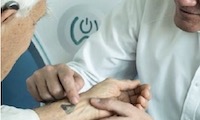
| Prof. Mark Kendall |
| Australian National University |
| Dehydration |
| Diagnostic device |
Key outcomes:
- Australian spin-off company WearOptimo was formed as a result of NFMRI medal prize
- Multi-million funding round from Aspen Medical
- Sensor technology is heading into production with a $30m deal, which includes funding an advanced technology facility in Brisbane, QLD
- This funding from the QLD Government, WearOptimo and ANU will build a globally competitive high-tech manufacturing facility that will produce 26m sensors each year
- Awarded two grants from the Australia Government (>$1.8m) under the MTP Connect Biomedical Technology Horizons Grants Program
- Over 15 MicrowearableTM sensor patents have been granted to date
“Professor Kendall received a $50,000 award, in the form of a research grant, after being awarded the Dr John Dixon Hughes OAM Medal in 2017. This funding was applied towards the development and evaluation of a MicrowearableTM sensor for hydration monitoring. Since then, an Australian spin-off company, WearOptimo, was formed developing unique, functional diagnostic wearables for a range of consumer and medical applications.“
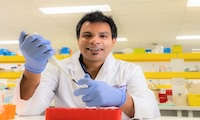
| Dr. Prashant Bharadwaj |
| Edith Cowan University |
| Alzheimer’s disease |
| Diagnostic |
Key outcomes:
- WA Child Research Foundation, $250,000
- Department of Health WA/FHRIF, $160,000
- Alzheimer’s Research Australia, $300,000
- Channel 7 Telethon grant – childhood dementia, $100,000
- Stan Perron Foundation, $450,000
- WA Child Research Foundation, $450,o00

| Prof Nicholas Opie |
| The University of Melbourne |
| Paralysis |
| Device |
Key outcomes:
- Establishment of spin-off company, Synchron which is now valued at approximately A$1.5 billion
- Has successfully implanted its Stentrode brain-computer interface in 10 patients with severe paralysis
- Successfully raised over A$545m, including A$308m (Series D)
- Received seed funding from the U.S. Defense Advanced Research Projects Agency (DARPA) ONR Global and the U.S. Department of Defense (DoD), $1,331,325 + $154,823
- Successfully implanted the StentrodeTM into four participants with severe paralysis due to MND
- StrentrodeTM granted Breakthrough Device designation by the U.S. FDA
- Synchron received nearly $1m from the MRFF
- $1,651,685m NHMRC project grant to expand the clinical study of the StrentrodeTM
- NHMRC Development grant, $810,382
“This project received funding in 2017-2018 from NFMRI to support safety validation of the StentrodeTM, which was developed by A/Prof. Nicholas Opie and his team. The StentrodeTM is an end-vascular brain-machine interface that can record neural signals from within a blood vessel. This technology is designed to restore instrumental activities of daily living in people with paralysis by sensing brain activity and translating these signals into discrete electrical commands which enable direct brain control of computers and assistive technology”

| Prof Steven Wise |
| The University of Sydney |
| Cardiovascular |
| Treatment |
Key achievements to date:
- Successful establishment of spin-off company NanomedX with private seed funding of over $790,000
- Sydney Local Health District – Accelerating Translation of New Cardiovascular Devices and Materials, $361,752
- Heart Foundation Future Leader Fellow Level 3, $593,126
- NSW Cardiovascular Initiative, $727,423
- MTPConnect TTRA Research Project, $739,128
- NSW Cardiovascular Senior Scientist Grant, $746,488
- University of Sydney FMH Biomanufacturing Incubator, $250,000
- MRFF/TTRA Program, $750,000 Tranche A investment to help drive the innovation towards human trials, as well as a further $375,000 available if milestones are met.

